Welcome to RVForums.com

  • Register now and join the discussion
  • Friendliest RV Community on the web
  • Modern site for PC's, Phones, Tablets - no 3rd party apps required
  • Ask questions, help others, review campgrounds
  • Get the most out of the RV Lifestyle
  • Invite everyone to RVForums.com and let's have fun
  • Commercial/Vendors welcome

Battery charging

Welcome to our community

  • Register now and join the discussion
  • Modern secure site, no 3rd party apps required
  • Invite your friends and let's have fun
  • Commercial/Vendors welcome
  • Friendliest RV community on the web

stegeeman

RVF Newbee
Joined
May 10, 2026
Messages
2
Greetings,
New to the RV world as we just purchased a 2020 Winnebago Boldt KL. I have been reading through the manuals and trying to understand the workings of the batteries. We have a Volta system that powers the RV and a separate battery to start the engine. I am looking for advice on how to maintain the chassis battery as we have not driven the RV for a few weeks and had to jump start the engine yesterday. Reading through the manual it talks about disconnecting the main battery switch but then I hear folks say that is not a good thing. My understanding is the solar panels on the roof will help maintain the Volta system but will not help maintain a charge on the chassis battery. Plugging in the house 120v to the RV will only charge/maintain the Volta system likewise with the 30 amp shore power line. What do you all recommend for maintaining a charge on the chassis battery when the RV sits for a period of time? Thanks so much for your advice! Looking forward to enjoying our Boldt but have a learning curve to tackle first.
 
Put a battery tender on it.
 
Greetings,
New to the RV world as we just purchased a 2020 Winnebago Boldt KL. I have been reading through the manuals and trying to understand the workings of the batteries. We have a Volta system that powers the RV and a separate battery to start the engine. I am looking for advice on how to maintain the chassis battery as we have not driven the RV for a few weeks and had to jump start the engine yesterday. Reading through the manual it talks about disconnecting the main battery switch but then I hear folks say that is not a good thing. My understanding is the solar panels on the roof will help maintain the Volta system but will not help maintain a charge on the chassis battery. Plugging in the house 120v to the RV will only charge/maintain the Volta system likewise with the 30 amp shore power line. What do you all recommend for maintaining a charge on the chassis battery when the RV sits for a period of time? Thanks so much for your advice! Looking forward to enjoying our Boldt but have a learning curve to tackle first.
If you are plugged into shore power (15 or30 Amp) as Boat Bum suggests a Battery Tender is you solution. https://www.amazon.com/Battery-Tender-021-0128-Maintain-Damaging/dp/B00068XCQU/?tag=rvf01-20
 
OR, install a disconnect switch on the negative battery terminal like I have. They even make them wireless with bluetooth now.
 
mine has a small thing that bridges the chasis battery and house batteries under the step. I dont remember what it ys called. This keeps the chasis battery topped off.
Jack
 
On my boat that was called a battery combiner.
 
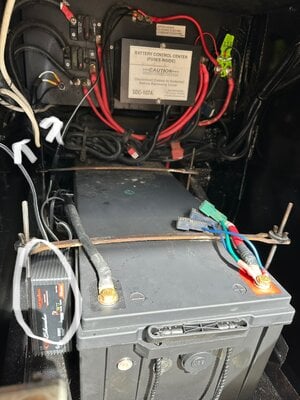
I always have our rv plugged in when stored. In the picture is a battery tender plugged into a 110 outlet on the rv and tied to a chassis battery connection in the compartment. That way anytime the rv is plugged into the chassis battery is trickle charged. Some rv’s do this automatically, but I’ve had issues and this was an easy solution.
 

Attachments

  • IMG_2722.jpeg
    IMG_2722.jpeg
    1.3 MB · Views: 0
I have both actually....120v power is not always available in the boondocks and I can't see using my inverter to charge a battery that can be disconnected.
 
I have both actually....120v power is not always available in the boondocks and I can't see using my inverter to charge a battery that can be disconnected.
Boondocking does change things, but I was really focused on the storage of the RV. Now I don’t boondock for more than a few days usually and I don’t have solar so when I start the generator to charge the house batteries it also charges the chassis battery. Anyway, both solutions solve the problem.
 
If your battery is original from 2020, maybe you need a new chassis battery.


I feel bad telling you coaches made during covid years were poorly made.
 
I always have our rv plugged in when stored. In the picture is a battery tender plugged into a 110 outlet on the rv and tied to a chassis battery connection in the compartment. That way anytime the rv is plugged into the chassis battery is trickle charged. Some rv’s do this automatically, but I’ve had issues and this was an easy solution.
Batteries are stupid. They only can do one thing: store electricity. They need a human and/or a microprocessor to oversee them. The micro processor works 24/7/365 without intervention.
The battery tender is NOT a "trickle charger". It is a 3 stage/smart charger designed to maintain a battery. Call it a tricle charger at the factory is a supreme insult. I worked at that coany for a short while, back 15 years ago,

Difference: A smart charger uses a microprocessor to regulate the charge, and will not overcharge it.

The smart charger has three stages, regardless of the amp ratings:
The first stage is at 15V, maximum current for a short period of time.
then it switches t the bulk mode at 14.2 V and harges the battery to 90-95 %. The micro proc senses it being charged and automatically reverts to:
13.3 volts, whick finishes the 100% charge and stays at this vltage to maintain charge. Suppose, you have one in your motor home on the house battery system, and you have an automatic vent fan. The fan kicks on, draws current and the battery comes off 100%. The smart charger kicks in automatically, and recharges the battery as above.
Note: there are chargers which are regulated at 13.2 V. They will maintain a battery, and not boil it out. However, they will take a long time to charge
ee below:
A "Trickle charger" is an unregulated charger which puts out a small current. However, when the battery reaches full charge, the trickle just keeps pumping current into the battery. This excess power becomes heat internal to the battery and can very well "boil" the electrolyte out over a period of time. Even if its an amp or so.
To us engineers who design battery systems, we refer the "trickle charger" as: "A device designed to sell batteries.". Really!

In my past boats, i used a smart charger on all battery banks, and leave the boat plugged into shore power all the time when not actually being used.
I replaced a battery last year, the store brand at Walmart, the carried a sticker of manufacturer: 6/12. or 14 years old. It still started the small block Chevy, the amp-hours suffered from age. Whatever I am doing, it seems to be working.
Now, for you BoonDockers, solar panels on the roof of the M H or TT is the best way.
NOTE: check the electrolyte in the lead acid type batteries ever few months or so, and refill using ONLY distilled water.

Another thought: most RVs have a "Voltage converter" which runs 12 stuff while docked. most if these are not 3 stage battery chargers. read the manual for it. or call the manufacturer. a solution:
Go to bass pro shops, and purchase a 3 stage/smart charger. They come in 1,2,3,and 4 batteries as well as different "amp" ratings. For the RV a 10 0r 15 amp smart will be more than sufficient. Simply wire it to ALL the batteries individually (this is not rocket science), plug it in and leave it alone. Somewhere under $200 for a quality unit, and it will pay for itself as saving your batteries.
 
Batteries are stupid. They only can do one thing: store electricity. They need a human and/or a microprocessor to oversee them. The micro processor works 24/7/365 without intervention.
The battery tender is NOT a "trickle charger". It is a 3 stage/smart charger designed to maintain a battery. Call it a tricle charger at the factory is a supreme insult. I worked at that coany for a short while, back 15 years ago,

Difference: A smart charger uses a microprocessor to regulate the charge, and will not overcharge it.

The smart charger has three stages, regardless of the amp ratings:
The first stage is at 15V, maximum current for a short period of time.
then it switches t the bulk mode at 14.2 V and harges the battery to 90-95 %. The micro proc senses it being charged and automatically reverts to:
13.3 volts, whick finishes the 100% charge and stays at this vltage to maintain charge. Suppose, you have one in your motor home on the house battery system, and you have an automatic vent fan. The fan kicks on, draws current and the battery comes off 100%. The smart charger kicks in automatically, and recharges the battery as above.
Note: there are chargers which are regulated at 13.2 V. They will maintain a battery, and not boil it out. However, they will take a long time to charge
ee below:
A "Trickle charger" is an unregulated charger which puts out a small current. However, when the battery reaches full charge, the trickle just keeps pumping current into the battery. This excess power becomes heat internal to the battery and can very well "boil" the electrolyte out over a period of time. Even if its an amp or so.
To us engineers who design battery systems, we refer the "trickle charger" as: "A device designed to sell batteries.". Really!

In my past boats, i used a smart charger on all battery banks, and leave the boat plugged into shore power all the time when not actually being used.
I replaced a battery last year, the store brand at Walmart, the carried a sticker of manufacturer: 6/12. or 14 years old. It still started the small block Chevy, the amp-hours suffered from age. Whatever I am doing, it seems to be working.
Now, for you BoonDockers, solar panels on the roof of the M H or TT is the best way.
NOTE: check the electrolyte in the lead acid type batteries ever few months or so, and refill using ONLY distilled water.

Another thought: most RVs have a "Voltage converter" which runs 12 stuff while docked. most if these are not 3 stage battery chargers. read the manual for it. or call the manufacturer. a solution:
Go to bass pro shops, and purchase a 3 stage/smart charger. They come in 1,2,3,and 4 batteries as well as different "amp" ratings. For the RV a 10 0r 15 amp smart will be more than sufficient. Simply wire it to ALL the batteries individually (this is not rocket science), plug it in and leave it alone. Somewhere under $200 for a quality unit, and it will pay for itself as saving your batteries.
Thanks for the detailed explanation. Appreciate the help and I feel like I am on the right path now-thanks again!
 

Latest resources

Back
Top Bottom