Welcome to RVForums.com

  • Register now and join the discussion
  • Friendliest RV Community on the web
  • Modern site for PC's, Phones, Tablets - no 3rd party apps required
  • Ask questions, help others, review campgrounds
  • Get the most out of the RV Lifestyle
  • Invite everyone to RVForums.com and let's have fun
  • Commercial/Vendors welcome

House Battery getting hot

Welcome to our community

  • Register now and join the discussion
  • Modern secure site, no 3rd party apps required
  • Invite your friends and let's have fun
  • Commercial/Vendors welcome
  • Friendliest RV community on the web

TEO

RVF Supporter
Joined
Jul 20, 2025
Messages
42
Location
Goodyear AZ
RV Year
2018
RV Make
Newmar
RV Model
Bay Star 3124
RV Length
32
Chassis
Ford
Engine
Triton V-10
TOW/TOAD
2014 Jeep Wrangler 2D
Fulltimer
No
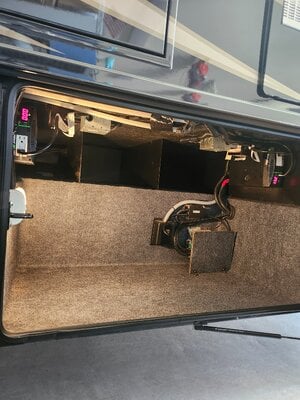
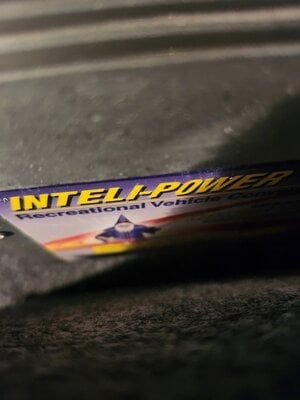
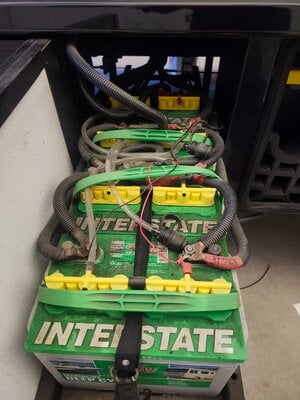
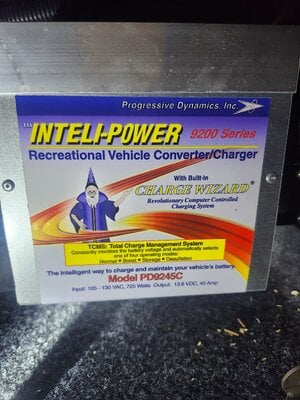
I store my 2018 Baystar in an rv garage at my mother's house, the other day she told me that there was a weird smell in the garage, today I dropped by and opened the door to the house battery tray and you could hear a hissing. Pulled the tray out and of the four Interstate group 24 lead acid battery's the second one was very hot and you could see moisture on the top of it. I unplugged the Inteli-power battery charger.
I have owned this for about 10 months and the battery's don't have a date sticker on them so unsure of the age, could be OE.
Couple questions,
Is it OK to leave the Inteli-power on when in storage?
We don't boondock so do I need 4 battery's?
 
I would check the water first…. But I am betting it is time to replace them….especially the one that got hot.

It is normally ok to leave a charger on, but it depends on the settings and keeping tabs on the battery maintenance.
 
Start from fresh and replace them. Yes you need batteries, even when plugged in to shore power the batteries provide power for stuff like lights, water pumps, fridge / ac / water heater control boards.... group 24 sounds small. maybe just invest in a singe 100aH lithium since you don't need the max storage. They don't get damaged if drawn way down of when an "inteli" anything becomes not so "inteli" and tries to cook them.
 
I would check the water first…. But I am betting it is time to replace them….especially the one that got hot.

It is normally ok to leave a charger on, but it depends on the settings and keeping tabs on the battery maintenance.
I installed a battery watering system right after I got this and topped them off about 2 week ago, so it shouldn't have been low on water.
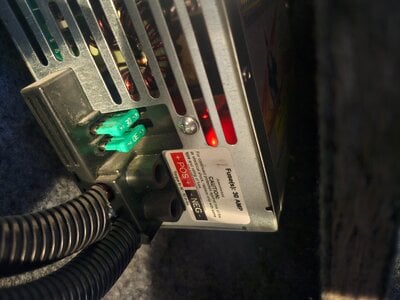
I will have remove a barrier to get a better look at the charger, can't see if there are settings to adjust.
 

Attachments

  • 20250808_142224.jpg
    20250808_142224.jpg
    2.3 MB · Views: 0
  • 20250808_142336.jpg
    20250808_142336.jpg
    926.1 KB · Views: 0
  • 20250808_142343.jpg
    20250808_142343.jpg
    1.1 MB · Views: 0
Four lead acid batteries is a lot of expense to periodically replace and a lot of weight. For about 25 years, I suffered along with maintaining a series pair of flooded lead acid 6 volt golf cart batteries, wired in series so they could stay balanced up while being the 12 volt house batteries in a Chevy P30 motorhome chassis. Bought new ones every 5 years or less, They were 115 to 140 bux each back then (last bought in 2010). once in a while, we got one that seeped acid from the git go, dangit!

Fast forward to 2025, our current (now a trailer type) camper got the LiFePo4 battery upgrade. Bought a 300 amp hour one for about 280 bux from Amazon, bought a 20 amp charger suitable for Lithium, put the battery in a Noco group 19 plastic battery box with one of those 50 amp lever style breakers screwed to the end of the box and now, no water to deal with, likely 10 year life cycle, weighs what one group 24 lead acid did, works great. We don’t deep discharge it, so the 20 amp charger is enough to bring it to full charge fast enough.

As the other poster suggested, the 100 amp hour Lithium might be enough. We also have one of those, in another group 19 Noco battery box (and use a loose lay 10 amp Lithium service charger), that we ride on the floor of the back seat in the crew cab truck that pulls the trailer. The 100 amp hour battery serves our piezo picnic day trip cooler so that the truck batteries are not involved. Weighs maybe 25 pounds.

Lithium will free you from the lead acid rig-a-ma-roll. Not really more expensive than multiple lead acid if you can do the upgrade yourself. Hope you get to a good solution!
 
group 24 batteries are typically 12 volt. Newmar typically used 6 volt LA in that vintage.
 
6 volt batteries that we used a pair of, wired in series to support 12 volt loads, were Exide size GC-5, standard form factor sold for golf cart deep cycle service. Heavy. A little taller than a group 24. 110 amp hours, but being lead acid, only 50 percent usable discharge capacity. A 100 amp hour LiFePo4 capable of discharge to 20 percent state of charge yielding 80 amp hours of load servicing almost matches four 6 volt golf batts, particularly if the 6 volt lead acid batterries are aging out or the elecyrolyte was let go below the tip of the plates a few times.
 
No you don't need 4 batteries.

Unless there is a problem with the charging circuit you can leave it plugged in, and charging.

Reality is the battery that is boiling is likely the newest battery. That assumes that someone had replaced one failing battery rather than all batteries.

If you never camp off grid a single battery will work fine. My suggestion is to remove all but one of your existing batteries and see if the one meets your demand. You can remove the batteries from the circuit without physically removing them.
 
No you don't need 4 batteries.

Unless there is a problem with the charging circuit you can leave it plugged in, and charging.

Reality is the battery that is boiling is likely the newest battery. That assumes that someone had replaced one failing battery rather than all batteries.

If you never camp off grid a single battery will work fine. My suggestion is to remove all but one of your existing batteries and see if the one meets your demand. You can remove the batteries from the circuit without physically removing them.
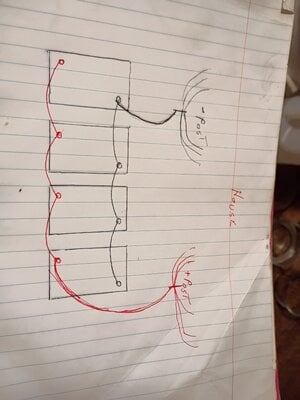
Thanks for the reply, Hadn't thought about just rewiring them in place. I will take a look at the way there currently wired and draw it out before taking anything apart. Some pictures also.
 
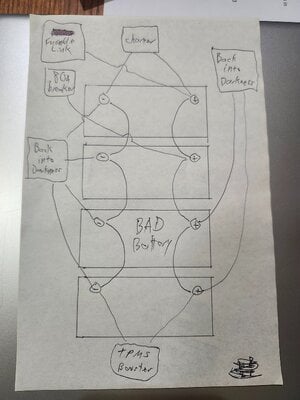
So here is the drawing of how my batteries are currently hooked up.
Just for simplicity I'm planning on moving the load wires from the first battery and the bad battery up onto battery 3 and 4 for now. Then I will remove two of the batteries and do a trip with the two that are left as a test run.
I need to trace the four positive cables and figure out what is what.
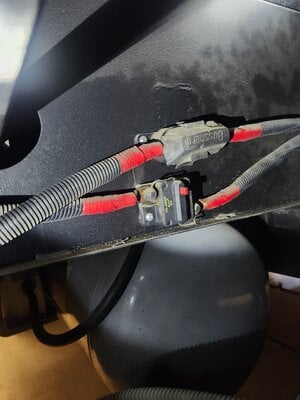
One has a breaker
One has a fuseable link
Two don't have anything near the batteries.
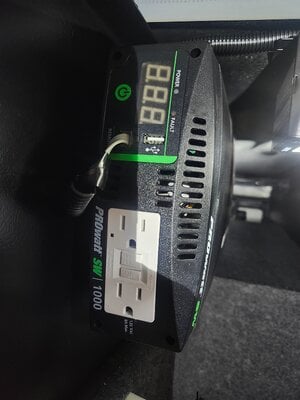
I do have two 1000W inverters so I assume that accounts for two?
One from the generator?
One from the charger?
Not sure why they all don't have some kind of overcurrent protection.
 

Attachments

  • 20260820_145827.jpg
    20260820_145827.jpg
    1.5 MB · Views: 0
  • 20260818_081401.jpg
    20260818_081401.jpg
    1.6 MB · Views: 0
  • 20260818_081345.jpg
    20260818_081345.jpg
    1.4 MB · Views: 0
  • 20260818_082418.jpg
    20260818_082418.jpg
    1.2 MB · Views: 0
  • 20260818_075437.jpg
    20260818_075437.jpg
    1.9 MB · Views: 0
Good job documenting what is there, which is four Interstate SRM-24 deep cycle 12 volt Group 24 flooded lead acid 81 amp-hour batteries, wired "ganged together" in parallel, essentially operating as one battery.

Although your coach would have four times the capacity as that of a single SRM-24 battery IF all four were new and fully charged, being ganged together precludes having individual charging control or individual load control on each battery.

It has often been said that even for just two flooded lead acid (FLA) batteries ganged together in parallell, one will be working while the other will be sulfating and in decline. The solution for that problem, in an installation desiring to have the combined capacity of two deep cycle FLA batteries, was to wire two 6 volt golf cart batteries in series. That way, the two became "one battery" of series-stacked cells, with current flow and charging /discharging occurring uniformly thru the two battery lash-up.

Given that your SRM-24 batteries are rated 81 amp-hours capacity each in the Interstate spec sheet, the four of them had a combined maximum capacity of 324 amp hours. In practice, you could now have three that have declined and sulfated, existing as "zombies" in the ganged set and resulting in only the newest one contributing any capacity.

You could remove all four of the old school flooded lead acid SRM-24 batteries and instead use a single 300 amp hour LiFePo4 battey with an upgraded replacement power converter (a lithium battery capable one) and accomplish what the four gang set was intended to provide, with greatly reduced weight, no acid drippage exposure nor hydrogen gas emissions, and the battery's internal BMS (battery management system) would keep the groups of cells within it balanced up just right, all on it's own (with a proper Lithium-service converter upgrade in place).

As for the wiring of loads attached to your system:: The parallelling of the four batteries created a single battery equivalent circuit. Yes, you have a breaker connected to the gang's circuit for one load branch and a fuse connected for another load branch. In a single LiFePo4 battery system, both loads are to be connected to the single battery, which electrical circuit wise, will be just the same function as the ganged arrangement.

I upgraded our 2019 Intech Flyer Explore TH from a single group 24 FLA battery to a 300 amp hour LiFePo4 bought via Amazon, plus a simple 20 amp power supply designed for Lithium service. (We don't boondock in the TH, so 20 amps recharges fast enough). Recently bought Mrs T a 2026 Intech OVR Navigate, which has a single 368 amp hour Expion model 360 LiFePo4 battery, rooftop solar and an inverter. Magical battery based performance there!

Looking back, our two golf cart FLA batteries that I put wired in series in the 1989 P30 Holiday Rambler motorhome that we had when the kids were young gave about a 210 amp hour capacity. Replaced those batts every 5 yesrs. Sometimes found the electrolyte boiled off below the tops of the cell plates from being on the unsophisticated standby converter charging circuit. I don't miss having to deal with all of that, from those bygone days of olde!

Perhaps you can load test your SRM-24 batteries individually after you pull them out. Might be three "zombies" there! If you can charge up each one individually on the bench before load testing, that would be best..

I pray that you will enjoy happy and safe camping, always!

 
So a rats nest! Might I suggest either a couple buss bars or posts. You can make your own posts using a bolt mounted to your non conductive wood wall.

This will bring all your wires to two points. As stated above, load testing should be done to verify the bad battery(s).

Your battery connections should not be on the same battery but should be distributed. (Positive on one end of the bank, negative on the opposite end of bank). This fact could be why the batteries were boiling.

This is not a suggestion, but nessisary.
 

Latest resources

Back
Top Bottom