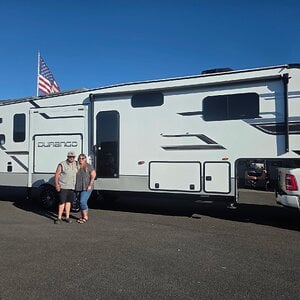
I just returned from a 4 day, 3 night camping trip to Bryce Canyon National Park. We stayed at
Ruby's Inn RV Park in Bryce City, Utah. This was a group trip with our local RV club. I highly recommend this venue, if you are visiting Bryce Canyon National Park. Full service RV park with a very large general store and buffet style restaurant right at the main gate of the park. You can see the entire park with Park Service shuttle buses that stop at the park.
Nothing but good Lightship news for the first outing involving an 800 mile round trip with the Lightship Turbo Edition in tow of the F-150 PowerBoost. Everything worked as advertised for the four day trip in both the LightShip and PowerBoost and nothing broke.
Some detail by subject area that comes to mind about this trip.
1. F-150 PowerBoost had additional stability control modifications made for this trip. I pulled the factory standard Hankook tires and replaced them
Load Range E tires Toyo Open Country A/T III at high pressure that maximizes cornering stiffness and enhances lateral g acceleration protection. And I added a Hellwig adjustable Rear Anti-Sway Bar to anchor the rear axle, preventing the body roll that often precedes a high-speed sway event. I continually found my speeds creeping up into the 70's without noticing any difference. Very different than my experience pulling my old 7,400 lb Airstream.
2. The LightShip Turbo Edition In-Motion V2V modification performed great. During all 800 miles of the trip the LightShip's built in EVSE was connected to the 4 pole 30 amp Ford ProPower on Board Inverter generator. I set the EVSE at 24 amps. The PowerBoost generator will support 30 amps output but that is the max rating so I decided to stay conservative for the first trip. The PowerBoost satisfied the LightShip demand outputting about 5.8 kWh to the LightShip. Net of conversion and line loss that means about 4.6 kWh was actually stored in the LightShip HV battery every hour. During the entire trip I left the PowerBoost in the on position even for breaks. That means the generator was running continuously for 7+ hours. So for this one way drive it would have been possible to add net of 31 kW to the battery had it not been at nearly 100% SOC at the beginning of the trip.
I noticed an interesting pattern with V2V continuous In-Motion charging. With the LightShip battery topped off at the maximum battery capacity set, the LightShip will only demand about 900 watts from the PowerBoost in motion. If the HVAC system is used you do not see an immediate demand increase from the PowerBoost above that 900 watt per hour base loading. Instead the HVAC draws only from the HV battery for a period of time. Then every few hours on the road the PowerBoost output will jump to 5.8 kWh for a period of time returning the LightShip battery to the original set max battery capacity. So the PowerBoost does not directly power the HVAC system, it is powered by the HV battery that decides when it wants to be replenished by the PowerBoost.
3. This trip was also an excellent test of the Lightship Turbo Edition brushed aluminum surface temperature thermal control system and the HVAC system. The campground was at 7,600'. For all three days we had a clear sky, with the sun at near maximum intensity one month before June 22nd. Day time highs were in the 70's F and night time lows in the 30s F. We needed air conditioning during the day and heat at night. As expected surface temperatures of the black exposed trim on the rear of the LightShip approached 180 F, while the surface temperature of the brushed aluminum wrap was 125 F. The factory standard tub paint came in at 155 F. The impact of the remaining black trim covering the rear of the LightShip was to transfer 130 F temperatures directly into the bathroom storage bins. I plan to cover the rest of the black trim on the back of the LightShip now. The bathroom was significantly hotter than the rest of the LightShip owing to this energy transfer from the black trim directly in back of the storage bins.

Exercising the HVAC system against the hot sun heat soaking the LightShip with the vinyl wrap was interesting. Even with high temperature only in the 70's the closed up LightShip easily heated up into the high 80's even with the highly reflective wrap. I can only imagine how hot it would have been with the original black paint exposed on the canopy. Sun intensity at 7,500 feet is 30% to 50% higher than at sea level. Because there is less atmosphere to filter out ultraviolet (UV) radiation, UV exposure increases by roughly 6% to 10% for every 1,000 feet of elevation gain. The HVAC system easily handled the load. There is an issue with placement of the cabin temperature sensor. Unless you keep the cabin HVAC system at least on the low setting, the Atlas reporting of the cabin temperature is about 10F higher than actual. This has been reported to LightShip and I found out it is a known issue.
With temperatures in the low 30's at night I also got to test the capacity of the HVAC heating mode. This morning was the lowest temperature of the stay at 29F. Overnight the cabin remained at the 72F set point all the way down to a 29F outdoor temperature. The heat pump in AeroHub was clearly being challenged at the low temperature making more noise than usual but it was keeping up with demand. I suspect that is probably about as good as it can do to maintain a 72F cabin temperature at 29F.
4. Living for 4 days and 3 nights in the Lightship is "different" than my experience in the Airstream for 5 years. Everything is stored at waist level down in the LightShip. In the Airstream at least 50% of storage is above your shoulders. I have not received my Cosmo "goodie" package which I understand includes some overhead storage bins. I suspect that I am going to use the bins (and probably get more) a great deal when I get them. But for now I have a standard LightShip storage system so everything is stored below the waist. I suspect the total cubic feet of storage in the Lightship is about the same as my 25' Airstream but much of the LightShip storage is in the Geararge which can only be accessed from the outside.
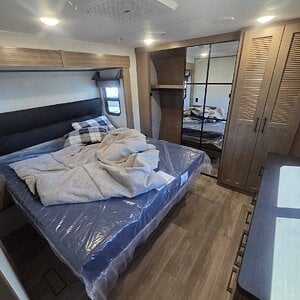
5. Sleeping in the Lightship is very comfortable but I did add a 1" foam topper for the mattress. That is a personal preference item. Your needs may be different. Great views of the night sky.
6. Owning a LightShip allows you to meet a lot of new people. Folks were constantly showing up at the door with questions about the LightShip. During the entire time in this RV park with many people stopping by and all of them veteran RV owners, not one of them had heard of the LightShip. LightShip may have to re-examine there marketing of this product. Many of these folks were Airstream owners as there was some kind of Airstream rally going on at this very large RV park.
7. The hot water is "hot" in the Lightship at around 135F. So 10 gallons with dilution of cold water will go a long way. The shower is excellent. During our 4 day, 3 night stay our water tank was down to 50%, gray tank up to 30% and the black tank at 20% with two people.
8. The BAL leveling system is capable but has a confusing interface that is near impossible to read in the sun. I was able to get things level in the manual mode but the Auto Mode and I need more work together.
9. Gap seal air leaks. I have two areas where there is daylight between the canopy and the tub, with the canopy up. This is an area about 3' long at the same position about half way back on the tub. I stuffed the gap with some towels but it is on the list for a factory visit this Summer. I also have some small gaps in the door seals as well. A cold front passed the last night with high wings that easily passed the gaps in the tub/canopy seals.
10. Security. The original LightShip camera system is not going to happened. I removed the control box for that system as it was fully powered together with the cameras. In its place I installed a rear, passenger side and driver's side
Reolink 4K security cameras together with a camera on the rear of the F-150. Anyone approaching within 10' feet of the LightShip, daytime or night is fully illuminated, recorded with appropriate notifications. Each of these little cameras also have an FTP function to upload triggered images to an FTP server. Given the interest in the LightShip this system was regularly tested by folks looking at the LightShip on evening walks. The cameras are easily viewed via WiFi in the tow vehicle on an iPhone or iPad making backing up the LightShip much easier.