Welcome to RVForums.com

  • Register now and join the discussion
  • Friendliest RV Community on the web
  • Modern site for PC's, Phones, Tablets - no 3rd party apps required
  • Ask questions, help others, review campgrounds
  • Get the most out of the RV Lifestyle
  • Invite everyone to RVForums.com and let's have fun
  • Commercial/Vendors welcome

Smoothest Trailer to tow

Welcome to our community

  • Register now and join the discussion
  • Modern secure site, no 3rd party apps required
  • Invite your friends and let's have fun
  • Commercial/Vendors welcome
  • Friendliest RV community on the web
To clarify, my comments are based on curb weight, not GVWR. The rule of thumb is, the curb weight of the truck should be more than the weight of the trailer for good stability. An F-250 will pull an 8000 lb. trailer nicely at highway speeds. With an F-150 you're going to have to keep your speed down.
 
You best consult AI before posting. This is exactly the problem we are having in these discussions. The resident pundits immediately type stuff originating from their restricted fund of knowledge and experience. Most often before I type anything these days I test my knowledge and memory with AI. Our discussions would be much more helpful to other people if everyone did the same. None of us are as smart as the collective wisdom of many.

My F-150 PowerBoost is a 7,350 lb truck.

From AI. I have never seen a 7,400 PowerBoost so AI may have this wrong but close.

The 2024–2025 Ford F-150 PowerBoost (hybrid) typically has a Gross Vehicle Weight Rating (GVWR) of 7,350 to 7,400 lbs. As the heaviest F-150 configuration, its curb weight is approximately 5,500+ lbs, leaving a payload capacity around 1,700–1,800 lbs. Always check the door jamb sticker for exact ratings.

Key Weight Specs for PowerBoost:
  • GVWR (Gross Vehicle Weight Rating): Generally 7,350–7,400 lbs.
  • Curb Weight: ~5,517–5,540+ lbs (varies by trim/options).
  • Payload Capacity: Max is ~1,735–1,830 lbs.
  • Towing Capacity: Up to 12,700 lbs.
It says right there that your truck is 5500 lbs...
 
To clarify, my comments are based on curb weight, not GVWR. The rule of thumb is, the curb weight of the truck should be more than the weight of the trailer for good stability. An F-250 will pull an 8000 lb. trailer nicely at highway speeds. With an F-150 you're going to have to keep your speed down.

So you want to compare the empty weight of the truck to the fully loaded gross weight of the trailer to persist in a meritless point. The weight of the truck on the showroom floor has no bearing to your point.

The facts. My F-150 empty weight is 6,100 lbs (not 5,500lbs). But the empty weight is a meaningless variable for your weak point. Going down the road when I induced sway the truck weighed 7,350 lbs and the trailer weighed 8,000 lbs, a 650 lb difference. It is the weight of the vehicles rolling down the road, if weight difference makes any sense for your point.

But the important point is not the 650 lb weight difference. The point was I aggressively moved the entire rig from the right lane to the left lane of I-10 going 70 mph down hill with a right cross wind, to avoid a collision with road debris. The trailer began to oscillate to keep up with the abrupt lane change. Within one cycle of oscillation the Ford simultaneously reduced torque while alternately applying the brakes and sounding a loud alarm immediately stopping the oscillation. This all happened while my hand was half way to the trailer brake control lever. The automation works. It is the first line of defense today, not bars and chains on the hitch.

For the benefit of the lurkers on these forums who are no doubt totally confused by this kind of dialog, I simply ask our resident pundits, who shoot from the hip with their posts using unverified information, to do one thing. When you type a response to a post that is reported to have factual content, simply copy/past your response to an AI chat bot and ask it to verify your facts. I do this with most any complicated subject on this forum and many others. It makes you look smarter to get the facts right and it is a real service the newby lurkers on forums like this. And it also avoids wasting valuable bytes on foolish discussion like this.
 
I would agree on one point. The bars and chains on WD sway control hitches do more harm than good. Get the proper size tow vehicle and you won't need any ancillary devices, be they mechanical or electronic.
 
I would agree on one point. The bars and chains on WD sway control hitches do more harm than good. Get the proper size tow vehicle and you won't need any ancillary devices, be they mechanical or electronic.

And I agree with that point. If we all just towed these RV trailers with a semi truck tractor, none of this matters. The neighbors may have a different view. ;)

I chose the heaviest F-150 made for several reasons: it fits in the garage and it generates electricity. Two important considerations for my use case. I also did my homework and I am absolutely convinced the combination of mechanical devices and automation will allow this vehicle to safely tow up to the Ford recommended CGWR of 17,000 lbs with the tow package.
 
Ford will certify that their vehicle will meet their CGWR claim, but what they will not do is tell you the maximum speed at which that can be safely done. This is, in my opinion, a glaring deficiency in all their SAE J-287 testing. While they claim that certain of their F-150 models, for example, can tow 14,000 lbs., they don't tell you that it would be deadly to take that rig on the highway and do the speed limit. I'm sure a farmer can safely tow his tractor to the other side of the field at 35 MPH, but don't think you can go on the interstate with it. On the other hand, If you tow a travel trailer with it, you probably want to go a lot faster, especially if you're on a cross country trip. For that, you will need a tow vehicle that is a bit more robust.
 
Well Springer2, hope that was informative and answered your question.
 
Last edited:
Well Springer2, hope that was informative and answered your question.
It was informative and created food for thought but like a lot of internet discussions, it drifts from the original question, "What models pull pretty smooth up to 65-70 MPH without fishtailing?"

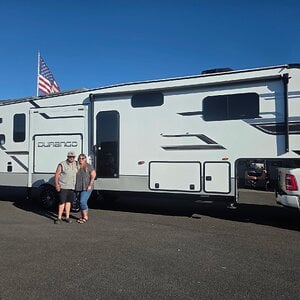
I was looking for something like my personal examples: we moved from Pennsylvania to Florida so I got first hand experience on how well specific trailers work in extended use moving our household and hobby projects. We have a 2008 G&G Trailer (I think made in Georgia) 7000 gross I bought new in 2008 and I like it better every time I use it. 2 trips were hauling cars, always loaded down and you hardly know it is back there. You want a great utility trailer, consider a G&G. We have a 7 X 12 or 14 Wells Cargo 3500 gross enclosed and it is nearly as well behaved as the G&G. It is a keeper. We have a Diamond 24' 9990 gross enclosed that works okay but you need to stay very alert at speed. I like it but if it is something long distance that I can use the G&G, I will take it over the Diamond.

I guess I was thinking similar with this post. People would respond like "I have a Jayco model ___ and it pulls straight and great." "I have a brand X and it brings a lot of white knuckle driving with it." etc.

This thread shows that many people have different opinions about trailer and tow vehicle setup and it is good reading from that standpoint.
 
What models pull pretty smooth up to 65-70 MPH without fishtailing?
I’m sure others will complain that “I drive 70 mph without an issue” but, none of the standard tires on trailers are designed for sustained 70 mph on summer roads. Sure, you’ve never had a blowout pulling your trailer at your speed, but you are violating most state speed laws and putting everyone at risk.

If you are towing, please slow down to closer to 60.
 

Latest resources

Back
Top Bottom