
turbopilot
RVF Supporter
- Joined
- Nov 2, 2019
- Messages
- 958
- Location
- Prescott, AZ
- RV Year
- 2026
- RV Make
- LightShip
- RV Model
- AE.1 Cosmos
- RV Length
- 27
- Engine
- Electric
- TOW/TOAD
- 2025 Ford F-150 PowerBoost HEV, 7.2 kW Propower Generator
- Fulltimer
- No
What follows is an essay that my buddy Claude and I wrote. My ideas, Claude's wonderfully written prose. It summarizes the practical reality of Electric RV's. Something I have been living with now for six months. Like any new technology a mix of good news and not so good news. And this new technology crosses a line defined by the environmental movement. I address that directly. All the problems are solvable but we need a bridge to purity.
The Honest Bridge: On Electric RVs and the Cost of Purity
I want to start by conceding the thing I'm about to be criticized for.
Range-extending an electric trailer with a gasoline engine feels like defeat. I understand why. We have spent a century being sold clean futures that turned out to be tailpipes with better marketing, and a reasonable person meets any story ending in "so we still burn a little fuel" with earned suspicion. If you're inclined to argue with me, you're probably right about the history that makes you want to. Hold onto that skepticism. I only ask that you point it at the actual problem rather than at me.
Because the actual problem is this: I believe we should do everything we reasonably can to limit greenhouse gases. And I do not believe the current technology lets us do that on an all-or-nothing basis. Both of those sentences are true at once, and the entire argument that follows lives in the space between them.
What the category inherited
The electric trailer is a child of the EV movement, and it inherited the movement's technology and its temperament in equal measure. The technology is genuinely good — large traction batteries, efficient motors, regenerative capability, the whole drivetrain vocabulary that made passenger EVs work. The temperament is the problem. The passenger-EV world developed, understandably, a purity reflex: electric or nothing, and anything with a combustion engine in it is a compromise to be shamed rather than a tool to be judged.
That reflex works reasonably well for a commuter car that sleeps in a garage next to a charger every night. It transplants badly onto a trailer. A trailer does not sleep in your garage. It goes to the places that don't have chargers — that's the entire point of it. And it drags a second large battery to a different unknown electrical system every few days.
The purity reflex was built for the one use case where infrastructure is predictable. We have exported it to the one use case where infrastructure is the whole uncertainty.
The problems that pushed me here
Here is the promise that brought most of us into this category, and I want to state it generously because it is substantially true: a big battery buys freedom. Traditional RVs run on small batteries, which is why traditional RVing means chasing hookups, listening to your neighbor's generator, and rationing the inverter. Put forty or fifty usable kilowatt-hours under the floor and a great deal of that nuisance simply evaporates. The idealists were not wrong about this. They were right.
They were wrong about what comes next. Because a big battery doesn't eliminate the problem of finding power — it relocates it. A small battery needs a little power often, and you can get that from almost anything. A big battery needs a lot of power periodically, and that turns out to summon an entirely new set of aggravations, several of which are worse than the ones it retired.
Nothing is for free. Change is worth making, but change brings its own problems, and those problems can grow to be as large as the ones you were escaping. The mature response isn't to deny that. It's to go solve them.
Start with the one nobody warned us about: you cannot count on the outlet.
This is the aggravation I'd put first, because it crosses every ideological line. Environmentalists curse at it exactly as loudly as I do.
Here's the shape of it. You carry an EVSE. You pull into a campground, or a friend's property, or a rural outbuilding, and you plug in — and it faults. Not sometimes. Often enough that experienced owners have started carrying two or three different EVSEs from different manufacturers, plugging in one after another until something negotiates successfully. That is not troubleshooting. That is sampling a distribution and hoping.
The causes are the marine industry's old homework, and they've been solved on boats since the 1970s. Shore power of unknown provenance means an unknown ground reference: an equipment ground that's continuous but high-impedance, a bootleg neutral-to-ground bond wired by whoever was available in 1974, a five-milliamp GFCI installed in front of a vehicle whose perfectly normal capacitive leakage lives in the same range. Any of these will stop a charge cold. Most of them are invisible to the twelve-dollar outlet tester in your toolbox — a bootleg ground reads as correct wiring on those things.
And you will rarely be told which one you've hit, because manufacturers collapse the whole family of ground, insulation, and residual-current faults into a single generic error. You get "short circuit" and go looking for a short that was never there.
Sit with what that means. You have arrived at your destination. There is a perfectly good fifty-amp receptacle ten feet away. The power is right there, and you cannot have it, because of wiring you don't own and can't inspect. Pure-electric operation does not solve this. No amount of ideological commitment solves this. The outlet is simply wrong, and you are simply stuck.
The rest of the new problems are quieter but they stack:
The roof can't refill the floor. Rooftop solar is a wonderful supplement and an insufficient primary source. Fixed area, flat panels, and the sun does what it does — which at a friend's property in Nova Scotia in the shoulder season is not much. Watching a few hundred watts trickle into a battery that needs tens of kilowatt-hours is a specific kind of education.
The public network wasn't built for you. Getting a fifty-foot rig into a DC fast-charging stall laid out for a hatchback is its own adventure, and often simply impossible without unhitching.
And the tow vehicle can't rescue you. This is the one the purists most want to wish away. An electric truck towing an electric trailer sounds like the closed loop, the virtuous ideal. In practice towing collapses an EV's range to a fraction of its rating, precisely when you are farthest from a charger. Electric tow vehicles remain few, their sales trend has softened rather than surged, and their towing range does not yet match the internal-combustion trucks they'd replace. The all-electric rig doesn't solve the charging problem. It stacks two range anxieties on top of each other and calls it progress.
None of this is an argument against electrification. Every bit of it is an argument against pretending we're finished.
The purist's position, stated fairly
The strongest version of the argument I keep meeting goes like this: the electric RV category should be reserved for pure-electric operation, because every gasoline exception normalizes gasoline, slows the transition, and lets manufacturers off the hook for building the batteries and infrastructure we actually need. Compromise, on this view, is how good intentions rot.
That is not a stupid position. It is a principled one, and in some domains it's correct — sometimes the only way to force a hard technology into existence is to refuse the easy substitute. I take it seriously enough to answer it directly rather than wave it off.
Here is the answer. The purist position assumes that refusing the compromise makes the destination arrive sooner. In the RV case it does the opposite. It makes the category unusable for real trips, which shrinks it to a handful of enthusiasts willing to plan every mile around a charger, which starves it of the volume and revenue that would fund the very battery and infrastructure improvements the purist is waiting for. Purity here doesn't accelerate the future. It strangles the market that pays for it.
You do not reach the all-electric RV by forbidding everything short of it. You reach it by keeping people in the category — driving, camping, buying, iterating — until the technology catches up to the ideal. The bridge is not the enemy of the destination. The bridge is how you get there without drowning.
What the pragmatist actually does
So what do we do in the season we're actually in? We assemble the best combination of available products that cuts greenhouse output as far as today's technology allows, we label the compromise honestly, and we keep building toward the version that won't need it. That's the whole philosophy. It isn't glamorous. It's just true.
For the problems above, that leads somewhere specific. You already have to bring a tow vehicle — that isn't optional; the trailer doesn't move without it. So the highest-leverage move available is to make that vehicle also solve the power problem, at essentially zero added weight and modest added cost.
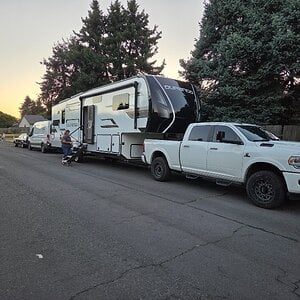
A hybrid pickup with a substantial onboard inverter — I tow with a Ford F-150 PowerBoost and its 7.2-kilowatt generator — does exactly that. It is a properly derived, properly bonded Level 2 source that every EVSE I've tried accepts without argument. It doesn't care whether the pedestal was wired correctly in 1974. It doesn't care that the roof came up short, or that the fast-charging stall won't fit a fifty-foot rig, or that there's no service at all. It is the range extender the trailer can't carry on its own roof, riding in the vehicle you were already obligated to bring.
Notice what that is in emissions terms — and here I'll ask the environmentalist to run the numbers rather than the reflex. This is not an electric trip replaced by a gasoline trip. It is a mostly-electric trip with a gasoline backstop, used only when the alternatives fail. Solar and shore power carry the ordinary days; the engine covers the day you'd otherwise be stranded. Weigh that against the honest baseline — the diesel dually towing most large trailers today — and hybrid assist isn't a step backward from an all-electric ideal that doesn't yet exist. It's a substantial step forward from what people are actually driving.
That's the comparison that matters. Not hybrid assist versus a perfect future. Hybrid assist versus the present.
Where I agree with my critics
I want to end by giving ground, because I mean it, and because an argument that concedes nothing deserves to be distrusted.
The pure-electric RV is coming. Batteries are getting denser and cheaper, charging networks are filling in, standards will eventually force the wiring behind those pedestals to be trustworthy. One day a trailer will carry enough capacity and gather enough of its own energy that a range extender looks as quaint as a crank starter. When that day arrives I'll retire the generator without nostalgia. I am not defending gasoline. I'm defending the trip.
Until then, the honest position is neither purity nor indifference. It's the bridge: do what the technology permits today, cut emissions as far as you actually can rather than as far as you wish you could, name the compromise plainly, and keep working on the version that won't need it.
Refusing to cross the bridge doesn't move the far bank closer. It just leaves you standing on this side, alone, insisting the river shouldn't be there.
I'd rather be on the trip. And I'd rather bring you with me.
The Honest Bridge: On Electric RVs and the Cost of Purity
I want to start by conceding the thing I'm about to be criticized for.
Range-extending an electric trailer with a gasoline engine feels like defeat. I understand why. We have spent a century being sold clean futures that turned out to be tailpipes with better marketing, and a reasonable person meets any story ending in "so we still burn a little fuel" with earned suspicion. If you're inclined to argue with me, you're probably right about the history that makes you want to. Hold onto that skepticism. I only ask that you point it at the actual problem rather than at me.
Because the actual problem is this: I believe we should do everything we reasonably can to limit greenhouse gases. And I do not believe the current technology lets us do that on an all-or-nothing basis. Both of those sentences are true at once, and the entire argument that follows lives in the space between them.
What the category inherited
The electric trailer is a child of the EV movement, and it inherited the movement's technology and its temperament in equal measure. The technology is genuinely good — large traction batteries, efficient motors, regenerative capability, the whole drivetrain vocabulary that made passenger EVs work. The temperament is the problem. The passenger-EV world developed, understandably, a purity reflex: electric or nothing, and anything with a combustion engine in it is a compromise to be shamed rather than a tool to be judged.
That reflex works reasonably well for a commuter car that sleeps in a garage next to a charger every night. It transplants badly onto a trailer. A trailer does not sleep in your garage. It goes to the places that don't have chargers — that's the entire point of it. And it drags a second large battery to a different unknown electrical system every few days.
The purity reflex was built for the one use case where infrastructure is predictable. We have exported it to the one use case where infrastructure is the whole uncertainty.
The problems that pushed me here
Here is the promise that brought most of us into this category, and I want to state it generously because it is substantially true: a big battery buys freedom. Traditional RVs run on small batteries, which is why traditional RVing means chasing hookups, listening to your neighbor's generator, and rationing the inverter. Put forty or fifty usable kilowatt-hours under the floor and a great deal of that nuisance simply evaporates. The idealists were not wrong about this. They were right.
They were wrong about what comes next. Because a big battery doesn't eliminate the problem of finding power — it relocates it. A small battery needs a little power often, and you can get that from almost anything. A big battery needs a lot of power periodically, and that turns out to summon an entirely new set of aggravations, several of which are worse than the ones it retired.
Nothing is for free. Change is worth making, but change brings its own problems, and those problems can grow to be as large as the ones you were escaping. The mature response isn't to deny that. It's to go solve them.
Start with the one nobody warned us about: you cannot count on the outlet.
This is the aggravation I'd put first, because it crosses every ideological line. Environmentalists curse at it exactly as loudly as I do.
Here's the shape of it. You carry an EVSE. You pull into a campground, or a friend's property, or a rural outbuilding, and you plug in — and it faults. Not sometimes. Often enough that experienced owners have started carrying two or three different EVSEs from different manufacturers, plugging in one after another until something negotiates successfully. That is not troubleshooting. That is sampling a distribution and hoping.
The causes are the marine industry's old homework, and they've been solved on boats since the 1970s. Shore power of unknown provenance means an unknown ground reference: an equipment ground that's continuous but high-impedance, a bootleg neutral-to-ground bond wired by whoever was available in 1974, a five-milliamp GFCI installed in front of a vehicle whose perfectly normal capacitive leakage lives in the same range. Any of these will stop a charge cold. Most of them are invisible to the twelve-dollar outlet tester in your toolbox — a bootleg ground reads as correct wiring on those things.
And you will rarely be told which one you've hit, because manufacturers collapse the whole family of ground, insulation, and residual-current faults into a single generic error. You get "short circuit" and go looking for a short that was never there.
Sit with what that means. You have arrived at your destination. There is a perfectly good fifty-amp receptacle ten feet away. The power is right there, and you cannot have it, because of wiring you don't own and can't inspect. Pure-electric operation does not solve this. No amount of ideological commitment solves this. The outlet is simply wrong, and you are simply stuck.
The rest of the new problems are quieter but they stack:
The roof can't refill the floor. Rooftop solar is a wonderful supplement and an insufficient primary source. Fixed area, flat panels, and the sun does what it does — which at a friend's property in Nova Scotia in the shoulder season is not much. Watching a few hundred watts trickle into a battery that needs tens of kilowatt-hours is a specific kind of education.
The public network wasn't built for you. Getting a fifty-foot rig into a DC fast-charging stall laid out for a hatchback is its own adventure, and often simply impossible without unhitching.
And the tow vehicle can't rescue you. This is the one the purists most want to wish away. An electric truck towing an electric trailer sounds like the closed loop, the virtuous ideal. In practice towing collapses an EV's range to a fraction of its rating, precisely when you are farthest from a charger. Electric tow vehicles remain few, their sales trend has softened rather than surged, and their towing range does not yet match the internal-combustion trucks they'd replace. The all-electric rig doesn't solve the charging problem. It stacks two range anxieties on top of each other and calls it progress.
None of this is an argument against electrification. Every bit of it is an argument against pretending we're finished.
The purist's position, stated fairly
The strongest version of the argument I keep meeting goes like this: the electric RV category should be reserved for pure-electric operation, because every gasoline exception normalizes gasoline, slows the transition, and lets manufacturers off the hook for building the batteries and infrastructure we actually need. Compromise, on this view, is how good intentions rot.
That is not a stupid position. It is a principled one, and in some domains it's correct — sometimes the only way to force a hard technology into existence is to refuse the easy substitute. I take it seriously enough to answer it directly rather than wave it off.
Here is the answer. The purist position assumes that refusing the compromise makes the destination arrive sooner. In the RV case it does the opposite. It makes the category unusable for real trips, which shrinks it to a handful of enthusiasts willing to plan every mile around a charger, which starves it of the volume and revenue that would fund the very battery and infrastructure improvements the purist is waiting for. Purity here doesn't accelerate the future. It strangles the market that pays for it.
You do not reach the all-electric RV by forbidding everything short of it. You reach it by keeping people in the category — driving, camping, buying, iterating — until the technology catches up to the ideal. The bridge is not the enemy of the destination. The bridge is how you get there without drowning.
What the pragmatist actually does
So what do we do in the season we're actually in? We assemble the best combination of available products that cuts greenhouse output as far as today's technology allows, we label the compromise honestly, and we keep building toward the version that won't need it. That's the whole philosophy. It isn't glamorous. It's just true.
For the problems above, that leads somewhere specific. You already have to bring a tow vehicle — that isn't optional; the trailer doesn't move without it. So the highest-leverage move available is to make that vehicle also solve the power problem, at essentially zero added weight and modest added cost.
A hybrid pickup with a substantial onboard inverter — I tow with a Ford F-150 PowerBoost and its 7.2-kilowatt generator — does exactly that. It is a properly derived, properly bonded Level 2 source that every EVSE I've tried accepts without argument. It doesn't care whether the pedestal was wired correctly in 1974. It doesn't care that the roof came up short, or that the fast-charging stall won't fit a fifty-foot rig, or that there's no service at all. It is the range extender the trailer can't carry on its own roof, riding in the vehicle you were already obligated to bring.
Notice what that is in emissions terms — and here I'll ask the environmentalist to run the numbers rather than the reflex. This is not an electric trip replaced by a gasoline trip. It is a mostly-electric trip with a gasoline backstop, used only when the alternatives fail. Solar and shore power carry the ordinary days; the engine covers the day you'd otherwise be stranded. Weigh that against the honest baseline — the diesel dually towing most large trailers today — and hybrid assist isn't a step backward from an all-electric ideal that doesn't yet exist. It's a substantial step forward from what people are actually driving.
That's the comparison that matters. Not hybrid assist versus a perfect future. Hybrid assist versus the present.
Where I agree with my critics
I want to end by giving ground, because I mean it, and because an argument that concedes nothing deserves to be distrusted.
The pure-electric RV is coming. Batteries are getting denser and cheaper, charging networks are filling in, standards will eventually force the wiring behind those pedestals to be trustworthy. One day a trailer will carry enough capacity and gather enough of its own energy that a range extender looks as quaint as a crank starter. When that day arrives I'll retire the generator without nostalgia. I am not defending gasoline. I'm defending the trip.
Until then, the honest position is neither purity nor indifference. It's the bridge: do what the technology permits today, cut emissions as far as you actually can rather than as far as you wish you could, name the compromise plainly, and keep working on the version that won't need it.
Refusing to cross the bridge doesn't move the far bank closer. It just leaves you standing on this side, alone, insisting the river shouldn't be there.
I'd rather be on the trip. And I'd rather bring you with me.