Welcome to RVForums.com

  • Register now and join the discussion
  • Friendliest RV Community on the web
  • Modern site for PC's, Phones, Tablets - no 3rd party apps required
  • Ask questions, help others, review campgrounds
  • Get the most out of the RV Lifestyle
  • Invite everyone to RVForums.com and let's have fun
  • Commercial/Vendors welcome

Beyond AGM replacement

Welcome to our community

  • Register now and join the discussion
  • Modern secure site, no 3rd party apps required
  • Invite your friends and let's have fun
  • Commercial/Vendors welcome
  • Friendliest RV community on the web

Travelman

RVF Newbee
Joined
Aug 30, 2026
Messages
2
Location
NC Washington
RV Year
2026
RV Make
Coachman
RV Model
Beyond 22D
RV Length
22
Chassis
Ford Transit
Engine
3.5 Eco-Boost
Fulltimer
No
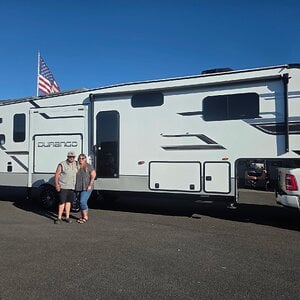
New to the forum as we just pulled the trigger on a Beyond 22D-good price on a 2026 because the new 2027 van are coming out. I wanted the 2026 because the new 27 don’t have a spare tire and the other changes seem minor for the price difference. We of course found the coach we liked (color and options)half way across the country but we are excited for the trip to pick it up.

I didn’t want the lithium model because they have eliminated the Cummins quiet generator for an additional alternator which seems like it could be a drag on mpg especially with large amp hours to recharge and I suspect trouble after a few years of heavy use, verses a 2.8 Cummins. So ours will have a 470 amp hour lithium battery replacing the stock Group 8D AGM battery (same size but lighter and maybe 3X the amp hours) and the quiet Cummins.

I am in the planning stage right now (ordering the battery, remote terminals etc). The dealer where I am purchasing the Beyond doesn’t seem too familiar with making the swap. I have watched a You Tube video on how easy it is to do (except for physically handling the 8D battery) but I can’t find anything on how to setup the Van’s system on recognizing lithium vs AGM. Has anyone made this lithium conversion on a 2025 or 2026 (with the Garmin) and could share the process to setup the new battery type?

Thanks, look forward to sharing our experiences and learning from The Coachman Owners Club.
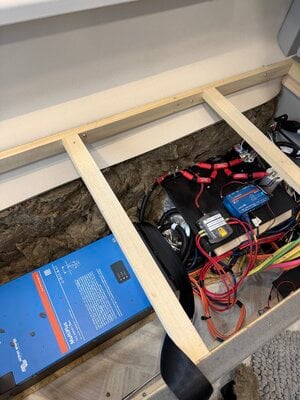
IMG_2049.jpeg


Chuck
Travelman
Have Hun-Will Travel
 
My opinion, for a number of reasons you made a good choice to avoid the under hood generator. The 8D AGM is about a 300 A/H capacity battery. The combination of going Lithium and increasing capacity you will need to determine if the alternator charging system can handle that new combination.
 
That nice new recent production coach will have a 120vac to DC power converter that is designed to also support lithium CC/CV charging. It may automatically handle the lithium battery properly when connected and powered up. Older models of some converters had a slide switch (accessible with the converter face trim removed) to set them for lithium service.

The converter manufacturer's online product listing for your converter model will describe whether it handles lithium automatically on its own or not. If your coach has the power converter present in the breaker panel as a combination unit, open the door panel on it and read the make and model so you can look that up.

Unless you need a fast recharge while driving, you might want to consider placing a DC to DC converter of a modest amperage delivery capability between your existing chassis battery/alternator electrical connection point and the lithium coach house battery's positive terminal.

Also adding a normally open relay contactor in series to power the DC to DC converter from the chassis battery/alternator will allow automatic turn on if you power the relay field coil from a "hot when chassis engine is operating" connection. Be sure to place a fuse or DC modular circuit breaker in front of the DC to DC power inlet connection, size your conductors properly, and place a separate fuse in front of the relay field coil. (I like to also add a spike protection diode between a DC relay field coil"s positive terminal and chassis negative ground to dump the coil energy when the field coil loses it's power feed at shutdown.)

Years ago, some coaches (our 1989 HR Alumalite, for example) had an automatic coach battery relay connection system consisting of a small controller out front that powered a "Bird Relay" contactor field to connect the 12 volt coach house battery for charging once the controller detected chassis battery voltage rising due to engine alternator being active. You could buy that (or a similar controller and contactor sold for that purpose) to automate powering the DC to DC converter during drive times.

The 120vac to DC power converter in your new coach may only have a charge current capability of 20 or 30 amps DC. If you don't require fast recharge while driving along (higher charge current might be highly desirable for significantly deep discharge of the lithium battery in camp, such as when boondocking), you don't have to buy a high amperage DC to DC converter to implement what I described above. Modest current load by using a DC to DC converter capable of charging your lithium battery at 30 amps or so won't overstress your alternator.

I pray for you to be blessed with safe travels and happy camping!
 
That nice new recent production coach will have a 120vac to DC power converter that is designed to also support lithium CC/CV charging. It may automatically handle the lithium battery properly when connected and powered up. Older models of some converters had a slide switch (accessible with the converter face trim removed) to set them for lithium service.

The converter manufacturer's online product listing for your converter model will describe whether it handles lithium automatically on its own or not. If your coach has the power converter present in the breaker panel as a combination unit, open the door panel on it and read the make and model so you can look that up.

Unless you need a fast recharge while driving, you might want to consider placing a DC to DC converter of a modest amperage delivery capability between your existing chassis battery/alternator electrical connection point and the lithium coach house battery's positive terminal.

Also adding a normally open relay contactor in series to power the DC to DC converter from the chassis battery/alternator will allow automatic turn on if you power the relay field coil from a "hot when chassis engine is operating" connection. Be sure to place a fuse or DC modular circuit breaker in front of the DC to DC power inlet connection, size your conductors properly, and place a separate fuse in front of the relay field coil. (I like to also add a spike protection diode between a DC relay field coil"s positive terminal and chassis negative ground to dump the coil energy when the field coil loses it's power feed at shutdown.)

Years ago, some coaches (our 1989 HR Alumalite, for example) had an automatic coach battery relay connection system consisting of a small controller out front that powered a "Bird Relay" contactor field to connect the 12 volt coach house battery for charging once the controller detected chassis battery voltage rising due to engine alternator being active. You could buy that (or a similar controller and contactor sold for that purpose) to automate powering the DC to DC converter during drive times.

The 120vac to DC power converter in your new coach may only have a charge current capability of 20 or 30 amps DC. If you don't require fast recharge while driving along (higher charge current might be highly desirable for significantly deep discharge of the lithium battery in camp, such as when boondocking), you don't have to buy a high amperage DC to DC converter to implement what I described above. Modest current load by using a DC to DC converter capable of charging your lithium battery at 30 amps or so won't overstress your alternator.

I pray for you to be blessed with safe travels and happy camping!
Thank you for your response. This is exactly what I was looking for-confirms my thinking with some experience.

I saved two items off my travel trailer (being sold). One is a 20/40 Renogy dc to dc charger with the wire and fuses. Your post gives me the confidence to install it in our new Van. Also I have a lithium 60 amp charger (I used with a separate generator on my old trailer to directly charge my lithium batteries by passing the converter). It makes sense to do the same thing on board in the Beyond.

I will install a switch for both additions. So while traveling I will have the option to charge at the Vans own 7 pin trickle charge or boost by 20 amps or boost by 40 amps.

And while stationary running the generator I can charge the batteries with the converters 30-40 amps or I should be able to boost by 60 amps charging by adding the extra charger with a switch. The lithium battery I am getting has a 300 amp BMS so should easily handle the 100 amp quicker charge.

Really appreciate your help. I will look into the diode application for both installations to handle the loads when disconnecting.

Cheers and God Bless You,
Chuck
 

Latest posts

Latest resources

Back
Top Bottom