You can have your opinion. But factually many solid core exterior doors are skinned MDF or chip board. Cut one down more then the 2" top or bottom inserted solid wood and you will see it.
Show me a solid plank oak , maple etc door thats 12" x 36"
you posted "Cherry, Mahogany and others are just fine for paneled cabinet doors (solid rails and stiles with glued and routed panels or furniture grade plywood panels)."
We are talking slab doors, not what you are talking about.
I specifcally said heat AND humidity.
As for pricing of a board foot of lumber, again, thats not what I was talking about. I was talking about veneered and wrapped MDF.
I hope this clears up what you misread.
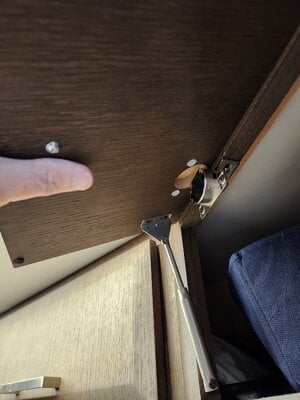
Well, I am a wood worker and cabinet maker, so I can certainly answer almost any question you propose, but staying on topic, If a manufacturer represents a particular component—such as a cabinet door, drawer front, shelf, or other piece—as
“solid wood,” I believe the customer should reasonably expect that component to be made from solid wood, not MDF or HDF disguised beneath a thin paper veneer.
That does not mean every part of a high-quality cabinet must be solid lumber. Traditional high-end cabinet construction has long used quality plywood for cabinet boxes, backs, drawer bottoms, panels, and other appropriate components. Those materials can actually provide greater dimensional stability than solid lumber in certain applications.
MDF and HDF also have legitimate uses in cabinetry. They are particularly well suited to painted doors and decorative panels because they machine cleanly, remain dimensionally stable, and provide an excellent painted surface. In a commercial cabinet shop, these components can also be produced very efficiently using CNC equipment. There is nothing inherently wrong with that construction, provided it is represented accurately to the customer.
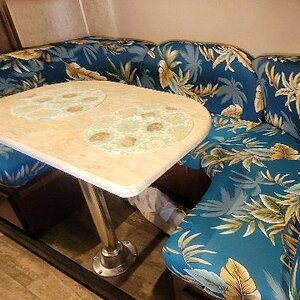
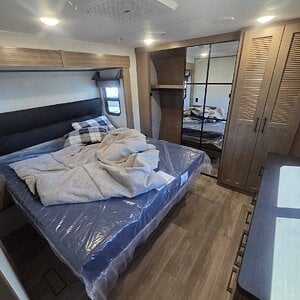
My concern arises when MDF or similar fiberboard is used as a lower-cost substitute for a component that is marketed or presented as premium solid-wood construction. In a high-end product—whether a home or a luxury motorhome such as a Newmar—I would expect the manufacturer to clearly disclose that distinction.
The same principle applies to doors. It is true that many modern solid-core doors use engineered cores with MDF, HDF, hardboard, with wood veneer skins. Those products can perform well and have legitimate applications. However, they are fundamentally different from a traditional high-end solid-wood stile-and-rail door.
For a premium wood door, a traditional construction such as mahogany stiles and rails with properly constructed solid-wood raised panels is a proven approach. The panels are allowed to float within the frame so natural expansion and contraction can occur without stressing the door. Properly designed, finished, and maintained, this type of construction has demonstrated excellent durability in demanding environments.
My objection is therefore not that MDF or HDF are inherently bad materials. It is that
material choice, construction quality, durability, and disclosure should be consistent with the price and claims being made about a premium product.