Welcome to RVForums.com

  • Register now and join the discussion
  • Friendliest RV Community on the web
  • Modern site for PC's, Phones, Tablets - no 3rd party apps required
  • Ask questions, help others, review campgrounds
  • Get the most out of the RV Lifestyle
  • Invite everyone to RVForums.com and let's have fun
  • Commercial/Vendors welcome

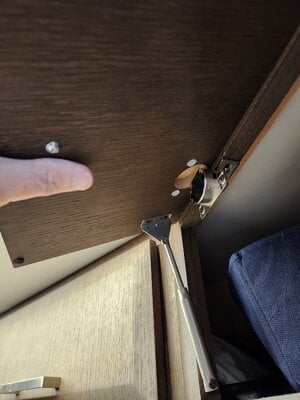
So much for solid wood cabinet doors. MDF on my 2023 Newmar New Aire cabinet doors.

Welcome to our community

  • Register now and join the discussion
  • Modern secure site, no 3rd party apps required
  • Invite your friends and let's have fun
  • Commercial/Vendors welcome
  • Friendliest RV community on the web
Curious, what about the other doors in the coach? Did you pull any to double check if they are solid wood? Just wondering if they made that door MDF to deal with the "heat" in that cabinet
As in the OP all appear to be MDF. Here is another pic of even the tiniest of small doors above the theatre seats. You can see the mdf the holes for the hinges exposes.
 

Attachments

  • 20260907_101610.jpg
    20260907_101610.jpg
    1.3 MB · Views: 0
Maybe the use of wood product would be less confusing. Cardboard (that's the word I use for it), is real wood product. It is worth defending because finish is applied and not a product of quality craftsmanship. And yes it cheapens any product made from it. I sometimes used it back in the day for router templates, never something I would sell.

But I am a lone wolf in this day of cheap products.
 
A few years ago we re-did the kitchen downstairs. I was amazed to find that high end cabinet suppliers use MDF cores or laminated Plywood and veneers. This approach does offer some finish options and i was educated as to how some of these done right are extremely durable. We ended up going with WEN. So far the stuff is durable, east to clean and we don't worry about it getting wet. In my motorhome finish damage from splash water in the kitchen and bath is evident. For my house down if Florida I became the king of Pergo for flooring and are even doing some walls in laminate. My motorhome is still carpet in the bedroom. The ugliest carpet you can imagine. Considering Pergo Premium with the foam cushion. As much as us older purists think only real wood will do there are some advantages to something else.
For my career I managed an automated warehouse. Every pallet was on a custom plywood carrier board. 46 X 54 X 1.25"thick. We had about 38,000 of these boards. My first intro to replacing them learn how specialized plywood products can be. Wat back then Rutland Plywood was suppler. They also made plywood for use as gun stocks.
 
A few years ago we re-did the kitchen downstairs. I was amazed to find that high end cabinet suppliers use MDF cores or laminated Plywood and veneers. This approach does offer some finish options and i was educated as to how some of these done right are extremely durable. We ended up going with WEN. So far the stuff is durable, east to clean and we don't worry about it getting wet. In my motorhome finish damage from splash water in the kitchen and bath is evident. For my house down if Florida I became the king of Pergo for flooring and are even doing some walls in laminate. My motorhome is still carpet in the bedroom. The ugliest carpet you can imagine. Considering Pergo Premium with the foam cushion. As much as us older purists think only real wood will do there are some advantages to something else.
For my career I managed an automated warehouse. Every pallet was on a custom plywood carrier board. 46 X 54 X 1.25"thick. We had about 38,000 of these boards. My first intro to replacing them learn how specialized plywood products can be. Wat back then Rutland Plywood was suppler. They also made plywood for use as gun stocks.
MDF has its uses, but one of its major limitations is use in any application involving articulation, hinges of any kind and fasteners. That’s an IKEA recipe for failure.
 
MDF has its uses, but one of its major limitations is use in any application involving articulation, hinges of any kind and fasteners.
For moving vehicles there is another downside! Weight!
 
For those doors, solid wood would not be stable enough to not warp with the heat and humidity. MDF is stable and will not warp. So its not a question of cutting corners. Those doors cost as much or more to manufacture the the standard raised panel doors.
The building I did had condos ranging from 2.5 mil to 65 mil and they used the same type of wrapped doors. MDF is incredible stable.
That is actually not accurate. As far as stability, Solid plank lumber such as Oak, Maple, Cherry, Mahogany and others are just fine for paneled cabinet doors (solid rails and stiles with glued and routed panels or furniture grade plywood panels). They are also fine for draw fronts. If they are kiln dried properly, they should handle the heat just fine. Moisture is actually the biggest problem and not the heat specifically. The heat certainly affects how dry the wood can become, whereas humidity affects the moisture content and warping. As far as cost, the North American average today is: Solid oak plank lumber typically costs $5.00 to $14.00+ per board foot, furniture-grade plywood runs $2.50 to $5.00 per board foot equivalent, and MDF is the most economical at $1.30 to $2.50 per board foot equivalent.

Have you ever seen a solid exterior door to a home or building made from MDF? Of course not. The extreme elements of sun, heat, cold and water would destroy MDF in shor order.

So as you can see, the comparisons are not even close. While MDF is certainly stable when not subjected to moisture, it is by all measures an inferior building material.
 
That is actually not accurate. As far as stability, Solid plank lumber such as Oak, Maple, Cherry, Mahogany and others are just fine for paneled cabinet doors (solid rails and stiles with glued and routed panels or furniture grade plywood panels). They are also fine for draw fronts. If they are kiln dried properly, they should handle the heat just fine. Moisture is actually the biggest problem and not the heat specifically. The heat certainly affects how dry the wood can become, whereas humidity affects the moisture content and warping. As far as cost, the North American average today is: Solid oak plank lumber typically costs $5.00 to $14.00+ per board foot, furniture-grade plywood runs $2.50 to $5.00 per board foot equivalent, and MDF is the most economical at $1.30 to $2.50 per board foot equivalent.

Have you ever seen a solid exterior door to a home or building made from MDF? Of course not. The extreme elements of sun, heat, cold and water would destroy MDF in shor order.

So as you can see, the comparisons are not even close. While MDF is certainly stable when not subjected to moisture, it is by all measures an inferior building material.
You can have your opinion. But factually many solid core exterior doors are skinned MDF or chip board. Cut one down more then the 2" top or bottom inserted solid wood and you will see it.
Show me a solid plank oak , maple etc door thats 12" x 36"

you posted "Cherry, Mahogany and others are just fine for paneled cabinet doors (solid rails and stiles with glued and routed panels or furniture grade plywood panels)."
We are talking slab doors, not what you are talking about.
I specifcally said heat AND humidity.
As for pricing of a board foot of lumber, again, thats not what I was talking about. I was talking about veneered and wrapped MDF.
I hope this clears up what you misread.
 
You can have your opinion. But factually many solid core exterior doors are skinned MDF or chip board. Cut one down more then the 2" top or bottom inserted solid wood and you will see it.
Show me a solid plank oak , maple etc door thats 12" x 36"

you posted "Cherry, Mahogany and others are just fine for paneled cabinet doors (solid rails and stiles with glued and routed panels or furniture grade plywood panels)."
We are talking slab doors, not what you are talking about.
I specifcally said heat AND humidity.
As for pricing of a board foot of lumber, again, thats not what I was talking about. I was talking about veneered and wrapped MDF.
I hope this clears up what you misread.
Well, I am a wood worker and cabinet maker, so I can certainly answer almost any question you propose, but staying on topic, If a manufacturer represents a particular component—such as a cabinet door, drawer front, shelf, or other piece—as “solid wood,” I believe the customer should reasonably expect that component to be made from solid wood, not MDF or HDF disguised beneath a thin paper veneer.

That does not mean every part of a high-quality cabinet must be solid lumber. Traditional high-end cabinet construction has long used quality plywood for cabinet boxes, backs, drawer bottoms, panels, and other appropriate components. Those materials can actually provide greater dimensional stability than solid lumber in certain applications.

MDF and HDF also have legitimate uses in cabinetry. They are particularly well suited to painted doors and decorative panels because they machine cleanly, remain dimensionally stable, and provide an excellent painted surface. In a commercial cabinet shop, these components can also be produced very efficiently using CNC equipment. There is nothing inherently wrong with that construction, provided it is represented accurately to the customer.

My concern arises when MDF or similar fiberboard is used as a lower-cost substitute for a component that is marketed or presented as premium solid-wood construction. In a high-end product—whether a home or a luxury motorhome such as a Newmar—I would expect the manufacturer to clearly disclose that distinction.

The same principle applies to doors. It is true that many modern solid-core doors use engineered cores with MDF, HDF, hardboard, with wood veneer skins. Those products can perform well and have legitimate applications. However, they are fundamentally different from a traditional high-end solid-wood stile-and-rail door.

For a premium wood door, a traditional construction such as mahogany stiles and rails with properly constructed solid-wood raised panels is a proven approach. The panels are allowed to float within the frame so natural expansion and contraction can occur without stressing the door. Properly designed, finished, and maintained, this type of construction has demonstrated excellent durability in demanding environments.

My objection is therefore not that MDF or HDF are inherently bad materials. It is that material choice, construction quality, durability, and disclosure should be consistent with the price and claims being made about a premium product.

 
Well, I am a wood worker and cabinet maker, so I can certainly answer almost any question you propose, but staying on topic, If a manufacturer represents a particular component—such as a cabinet door, drawer front, shelf, or other piece—as “solid wood,” I believe the customer should reasonably expect that component to be made from solid wood, not MDF or HDF disguised beneath a thin paper veneer.

That does not mean every part of a high-quality cabinet must be solid lumber. Traditional high-end cabinet construction has long used quality plywood for cabinet boxes, backs, drawer bottoms, panels, and other appropriate components. Those materials can actually provide greater dimensional stability than solid lumber in certain applications.

MDF and HDF also have legitimate uses in cabinetry. They are particularly well suited to painted doors and decorative panels because they machine cleanly, remain dimensionally stable, and provide an excellent painted surface. In a commercial cabinet shop, these components can also be produced very efficiently using CNC equipment. There is nothing inherently wrong with that construction, provided it is represented accurately to the customer.

My concern arises when MDF or similar fiberboard is used as a lower-cost substitute for a component that is marketed or presented as premium solid-wood construction. In a high-end product—whether a home or a luxury motorhome such as a Newmar—I would expect the manufacturer to clearly disclose that distinction.

The same principle applies to doors. It is true that many modern solid-core doors use engineered cores with MDF, HDF, hardboard, with wood veneer skins. Those products can perform well and have legitimate applications. However, they are fundamentally different from a traditional high-end solid-wood stile-and-rail door.

For a premium wood door, a traditional construction such as mahogany stiles and rails with properly constructed solid-wood raised panels is a proven approach. The panels are allowed to float within the frame so natural expansion and contraction can occur without stressing the door. Properly designed, finished, and maintained, this type of construction has demonstrated excellent durability in demanding environments.

My objection is therefore not that MDF or HDF are inherently bad materials. It is that material choice, construction quality, durability, and disclosure should be consistent with the price and claims being made about a premium product.
Ok so you are changing the topic. I do notice that earlier you said the center panels are glued into the stiles and rails but I did not want to bother mentioning that. I see you cleared that up now.
As for Newmar, I was never defending their choice. Simply stating the possible reason for the choice and I have yet to see where Newmar claimed the doors were not MDF cores. I would not question the quality as the OP has had no issue with quality
Not sure if you read where I previously posted that in the building I did, the units went from around 2 mil to 60 mil +. Every one of those units had wrapped slab doors with MDF cores. They were similar to this Newaire and the current crop of higher end MHs with slab doors. Not what I would choose but it was a Foster and Partners design. You can google Foster and Partners.
As a former custom cabinet shop owner, I am always open to learning but I usually find that I have pretty much covered all my bases and 20 to 30 years later, the kitchens, baths etc of the customers that I am still in contact with are still looking new. But I equate that to quality work and having quality customers who take care of their property.
 

Latest resources

Back
Top Bottom