
turbopilot
RVF Supporter
- Joined
- Nov 2, 2019
- Messages
- 961
- Location
- Prescott, AZ
- RV Year
- 2026
- RV Make
- LightShip
- RV Model
- Turbo Edition
- RV Length
- 27
- Engine
- Electric
- TOW/TOAD
- 2025 Ford F-150 PowerBoost HEV, 7.2 kW Propower Generator
- Fulltimer
- No
I have owned every type of RV generally based in the SouthWest US. The one thing they all shared was noisy, inefficient air conditioners and little tiny batteries. I mostly RV in the Summer. So with last century RV's I was always in quest of a power pedestal to stay cool. I've spent most of this year with a datalogger plugged into the truck, chasing fuel numbers and charging efficiency on a LightShip AE.1 behind an F-150 PowerBoost. Plenty of spreadsheets. But the thing I actually want to talk about isn't on any of them, and I didn't see it coming.First, the battery, because the size of it is hard to get your head around until you put it next to what we're all used to. 77 kilowatts under the floor.
A nicely equipped conventional trailer might carry 5 kWh of house battery — call it two or three 100 Ah lithiums. Older rigs with a pair of group-27 lead-acids are working with maybe 1.2 kWh you can actually use before you start killing the batteries. The LightShip has 77 kWh under the floor. That's roughly 15x the good lithium setup and something like 60x the lead-acid one. It is 5 Tesla PowerWalls.
Now put an air conditioner on that. A rooftop unit pulls somewhere around 1.2–1.5 kW while it's running. Run that math on the old trailer and you get why battery kilowatt anxiety was just part of the deal — an hour of AC, maybe two if you were careful. That's not air conditioning, that's a gesture. It's also why a legacy RV owner is permanently hunting for a pedestal in the Summer. The pole wasn't a nice-to-have, it was life support at many destinations across America
What it actually costs to stay cool — one real day
This Summer I have been on the road for 3 weeks in the LightShip successfully finding every heat dome in the country. I finally have a number for this instead of a guess, so here it is.Daytime highs near 100°F, overnight lows in the 70s. Climate system left to do its job for a full 24 hours with a set point of 75F, living in the trailer normally. Over a typical 24 hour period I lost 22% of state of charge in those temperatures — about 17 kWh off a 77 kWh pack.
Not all of that was air conditioning. Best I can tell roughly 8 kWh of it was base load — fridge, pumps, controls, all the stuff that runs whether you're paying attention or not — leaving something like 9 kWh for a full day and night of cooling in near-100°F heat. That base-load figure lines up with what I've measured elsewhere on this trailer, which floats somewhere between 200 and 900 W depending mostly on how hard the thermal system is working.
Straight-line that and you're at roughly four days before the pack is empty at those very high temperatures, and call it three to three and a half to a floor you'd actually be comfortable stopping at. In a heat dome. With the AC on the whole time.
I want to be clear that this is one observation, read off the Atlas display by eye at each end, not logged data — the trailer doesn't export SOC and I can't record it. The pack reads in whole percent, so there's a point of slop at each end. Cool nights in the 70s also do a lot of work here; a night that stays in the 90s would be a different number. And the roof solar was contributing across the day, so 17 kWh is the net drain — which is the right basis for "how many days can I sit here," but it isn't the gross load.
Still. One data point beats zero, and the shape of the answer is days, not hours.
Pulling in at 10 PM
The other place the size shows up is a small thing that turns out to be a big thing when you are tired and been driving all day.You get into the park late, you're beat. Old way: find the pedestal in the dark, dig out the adapter, sort out whatever 30/50 amp surprise is waiting, hope the breaker holds. New way: go to bed. If there's power and you feel like plugging in tomorrow, great. If not, also fine. The trailer genuinely does not care.
And that's before the towing side. With V2V in-motion charging, the truck's ProPower inverter feeds the trailer through the umbilical the whole time you're rolling. I've measured a steady 5.8 kW at the connection across seven separate legs, and the rate never sagged no matter how hot it got. So the drive isn't draining the house battery — the drive is a charging session that happens to cover 400 miles. AC ran all day too, so you open the door to a cool trailer instead of a 120°F oven that needs an hour to recover.
Put those two together and you can see why the pedestal stops mattering much. A day's driving puts back more than a day at camp takes out. Three weeks on the road and I plugged into a pedestal less than half the nights, and most of those nights I really did not have to.
OK, but here's the actual best part
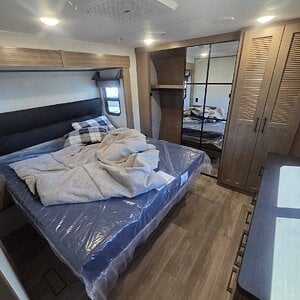
Sleeping. I'm serious.Quick description of the system, because it isn't built like anything I've owned before. LightShip calls it AirRight — 20,000 BTU of cooling, 16,000 BTU of heat, 500 CFM of airflow, all running off the high-voltage pack and set from the Atlas screen. The equipment lives up in the AeroHub, not in a box screwed to the roof over your head. From there the cabin ducting runs a semicircle around the bed, about three feet off the floor, and discharges at the top of that loop, so the cool air drifts down over you in a roughly 270-degree arc while you sleep. Once the system reaches the set point, you can't hear it running. This alone is a miracle compared to the days that Dometic AC cycling on and off as it was rattling over head all night.
For the curious: poking around the fuse panel, it's two interior blower fans, three coolant pumps, two radiator fans, plus reversing valves, expansion valves and four pressure transducers. That reads like a reversible refrigerant loop — a heat pump, not a one-way AC — which lines up with the 16,000 BTU heat rating. I'll flag that as my read of the hardware list rather than something LightShip documents. The practical upshot is that it moves a lot of air slowly, from a long way away, instead of a little air fast from directly above your face. That's the whole reason it's quiet.
What it feels like: 95°F and humid outside, and you're in a cocoon of cool air moving silently around the perimeter of the bed. No compressor drone six feet above your head. No cycling thump that wakes you at 2 AM. The fan is always running, it never stops it just changes speed. Like sleeping outside on a cold winter night. I've spent a lot of nights in RVs and I have never slept like that in one.
None of it works without the battery. You could build the same beautifully ducted system into any trailer you like — if the house bank runs it for 90 minutes, it's a party trick. 77 kWh at 22% a day is what turns it into something you just leave on. And not just sleeping. The air conditioner is running all day while the LightShip is in motion. That is baked into the 24 hour kilowatt use above.
Cool, quiet comfort, great sleep and no kilowatt anxiety. There is no way to make this happen in an RV without a big ass battery.