Welcome to RVForums.com

  • Register now and join the discussion
  • Friendliest RV Community on the web
  • Modern site for PC's, Phones, Tablets - no 3rd party apps required
  • Ask questions, help others, review campgrounds
  • Get the most out of the RV Lifestyle
  • Invite everyone to RVForums.com and let's have fun
  • Commercial/Vendors welcome

(Live Updates) Florida 1/14 to 1/23 - Tampa show + real world use

Welcome to our community

  • Register now and join the discussion
  • Modern secure site, no 3rd party apps required
  • Invite your friends and let's have fun
  • Commercial/Vendors welcome
  • Friendliest RV community on the web
@Blackstone ... Cybertruck beats Rivian in this regard. The R1T only has 120 volt outlets in the bed. One of my biggest fears (on high mileage travel days) is decoupling the trailer if my only available option is an Electrify America at a Walmart. I'm thinking I'll become very versed, very quickly on where the pull-through DCFC's are and only use those.

Putting the Cybertruck into my test cases. I think my overall conclusions hold, but the Cybertruck does deliver some advantages because of the 240 volt capability in the bed. I'm not across the Cybertruck capability, but I'm assuming the 240 volt in the bed is akin to Level 2 charging, or in other words, what you'd reasonably expect from an EVSE at campsite. Crucially, it's not Level 3, or DCFC.

On to my test cases (and I added one for transit scenarios):

1. Abundant, concurrent charging at destination, i.e., multiple pedestals / EVSEs, no load constraints

Play: Bias to travel speed. Use TrekDrive aggressively. Spend Lightship energy freely (respecting CER).
Why: Energy is liquid, speed/time can safely dominate.
Cybertruck advantage: n/a

2. Limited charging at destination, i.e., one pedestal or shared power

Play: Use TrekDrive. Arrive with R1T SOC higher than Lightship SOC, while respecting CER.
Why: A charged truck keeps options open, a charged trailer doesn’t.
Cybertruck advantage: Mild convenience advantage, i.e., you can plug in Cybertruck - or - Lightship and daisy chain to the other vehicle. I only have Lightship to R1T as an option, you are bi-directional.

3. No charging at destination (boondocking)

Play: Use TrekDrive until Lightship approaches CER. Preserve CER and as much R1T SOC as possible.
Why: Lightship can slowly recharge via solar, the truck is irreplaceable.
Cybertruck advantage: High convenience advantage, energy is now liquid as you can use the Cybertruck refill the Lightship, whereas I cannot do that with the R1T.

4. In transit charging

Cybertruck advantage: Medium convenience advantage. You can charge the Cybertruck on DCFC and the Lightship via daisy chain via Level 2 charging from the Cybertruck bed without decoupling. I think the issue here is the negligible SOC benefit you'd get from a 30 to 60 minute DCFC stop.

We're obviously brainstorming these scenarios, and these are my early views. If you see a hole in my logic I'll go back to token-blitzing my AI helper to get a better answer!
Thanks for the additions! Yea, the bed outlet is around 9kW I think, slightly slower than my 11kW wall connector at home.

It’s better than nothing, if charger layout doesn’t easily allow DC Level 3 charging both truck and trailer separately.

But probably worth unhitching time penalty if i can push 150kW into the trailer and it saves me charging time down the road. Might be worth getting one of those remote controlled robots that allows you to move trailers around 🤣
 
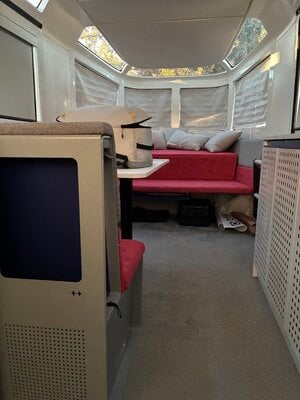
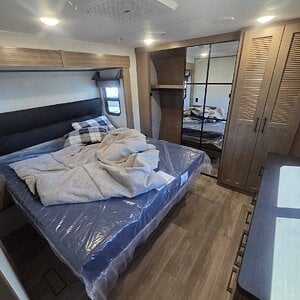
Night 1 done! I woke to a special view of oaks and Spanish moss through the skylights. This with all my main window blinds down… it’s awesome to have a view without having a view if you know what I mean!

It’s about 35 outside and was comfortable in cabin though the HVAC was a bit loud for my liking, will talk to our engineers about further damping.

Switchback was amazing, flip down flip up all set.

I’m all charged off the power pedestal with, 40% to 90% on trailer done in about 5 hours. ( I set the limit to 90% for battery health). We’ll dump tanks and refill with fresh water before heading out to meet a potential service partner on the way to Naples!

More soon.
 

Attachments

  • IMG_7254.jpeg
    IMG_7254.jpeg
    2.9 MB · Views: 14
It’s about 35 outside and was comfortable in cabin though the HVAC was a bit loud for my liking, will talk to our engineers about further damping.

I noticed the same thing last April in my Lightship overnight with temperatures down near freezing. Not an HVAC expert but what I think what is happening is that the high voltage heat pump increases RPM near the limits of its heat exchange capacity. On my F-150 PowerBoost HEV I can monitor the high voltage heat pump RPM which can increase to over 7,000 RPM when demand is high.

Telsa solved this problem when they moved away from PTC (Positive Temperature Coefficient) Heaters (Resistive Heating) systems and instead relied on heat pump heating using "lossy" heat generation in the battery, electric motor and electric components. "Lossy" heat generation is a process of running these electrical components inefficiently to generate heat. I think it is the same think happening during EV battery conditioning before charging.

If the LightShip does not have the capability to run these components in the "lossy" mode for heat generation, then I would recommend adding a PTC heater coil in the outflow of HVAC blower that could be toggled to activate optionally when hooked up to a power pedestal to avoid reducing the battery SOC. But of course the issue is easily resolved by the owner running resistive space heater any time the high voltage heat pump is running at high RPM's in the heat mode.

This was one of the topics I was looking forward to discussing in our upcoming systems review.
 
Greta feedback!! Will pass along to our team. We have already improved the isolators and tuned the controls of the hvac which made a big difference vs the vehicle you tested. But I think we can take it even further. Stay tuned!

New story on Instagram about pull through charging.
 
@Rory (Lightship Team) ... just saw your latest IG post. You chose to drive again without TrekDrive, was that to push the limits so you could 2-way charge the R1T, or a different choice?

Congratulations on selling a Lightship in transit. Hope they've got you on commission!
 
@Rory (Lightship Team) ... just saw your latest IG post. You chose to drive again without TrekDrive, was that to push the limits so you could 2-way charge the R1T, or a different choice?

Congratulations on selling a Lightship in transit. Hope they've got you on commission!
To be honest this isn’t a scientific route… I’m just trying to showcase lots of features!

That said, the next update should be very fun…

We’ll probably stack up many lightship sales over these couple days! No commission, but equity stake means we all are invested in company success via strong customer reception!
 
TempSplits.jpg


This is an interesting data point. It appears that it took 7.4 kW to sustain the LightShip overnight with a temperature difference of of 32F. @Rory (Lightship Team) that 7.4 kW is split between HVAC heating and the other loads on the battery in that time. Any guess what the base load per hour of the LightShip, not including HVAC and how many hours were included in that 7. kW usage datapoint?
 
View attachment 31040

This is an interesting data point. It appears that it took 7.4 kW to sustain the LightShip overnight with a temperature difference of of 32F. @Rory (Lightship Team) that 7.4 kW is split between HVAC heating and the other loads on the battery in that time. Any guess what the base load per hour of the LightShip, not including HVAC and how many hours were included in that 7. kW usage datapoint?
Great question. I estimate about 8 hours of heating. To be honest, this performance was better than I expected with such a large temperature delta. Base load I can’t say.
 
Ok let’s talk trekdrive. After the pop up yesterday, we lost the hitch pin (we had a crowd of 6 or 7 people swarm us when we arrived and I was distracted). So, after searching for a while for it, I sent Travis our videographer to the hardware store to get a bolt and nut to serve as a makeshift pin for safety (actually more safe a solution) see image below for example.

But it was getting dark and we had an hour to our campsite. The rivian had borrowed 7 kWh from the Lightship in the hour we had it plugged in via 240v. But it still only had 20% left and we had 42 miles to our campsite. The rivian told us we needed a charge.

We looked for pull through chargers, the one we found was about 50 miles away. No go.

We had an option to drop the trailer and just DCFC the truck, but we’d had such a constant flow of visitor the whole day that we were exhausted.

The trailer still had loads of battery. We could keep charging the rivian off the trailer but that would take too long.

Enter TrekDrive.

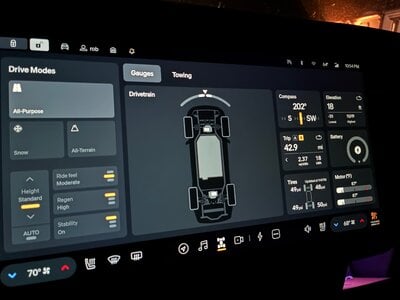
I switched into road mode and took off. My mi/kWh on the rivian went from 1.4 mi/kWh (1.6 mi/kWh when following semis on highways) to 2.4 mi/kWh. We covered the 42 miles no problem and arrived at the campsite with 9% left on the rivian.

Job done.

So stoked about this real world performance on a true trip, because this is exactly what we built this trailer to do. Nothing else on the market can do this, and it saved us a long night.

We plugged into 50 amp here at the site and the rivian is back to 80% overnight.

Heck yea.
IMG_7335.jpeg
 

Attachments

  • IMG_7329.jpeg
    IMG_7329.jpeg
    1.1 MB · Views: 4

Latest resources

Back
Top Bottom